Midwest City French Drain Installation, Oklahoma City, Norman, Edmond
French Drain Installation
Oklahoma Drainage has been diagnosing and solving Drainage Problems since 1993. Water has the ability to get into places around your home where you really don’t want it to be. Some drainage problems are easy to solve. Typically, water enters the problem drainage area one way from one source. The really tricky drainage problems occur when water enters the problem drainage area from multiple directions and from multiple sources. Sometimes a secondary water source can’t be seen or identified until the primary water problem source is eliminated.
An example of this occurs when water is running into a problem area in an obvious way over the ground where you can see it.
Simple enough.

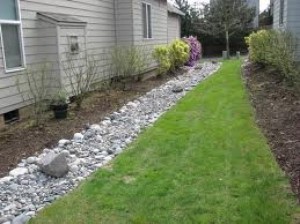
French Drains can be decorated with many types of stone
A drainage system
is installed with a surface drain as the “intake” with drainage pipe running to an exit point. Initially the water drains away and everything looks great. The next day water is back and is all around the surface drain, but below the edge and it hasn’t rained at all, so no additional water ran over the surface of the ground to flood the area. The primary water source was solved, ( The surface water run off ) but the secondary water source was not. Which was sub-surface water, (ground water) running into the area. A surface drain can’t drain “ground water.” A French Drain should have initially been installed instead of a Surface Drain. A French Drain can drain both Surface Water and Ground Water.

A French Drain Can Handle Standing Water
Oklahoma Drainage and Sprinkler Repair Services all of Central Oklahoma
including Norman, Moore, Edmond, Yukon, Mustang, Oklahoma City, Midwest City, Del City, Blanchard, Newcastle, Purcell and Chickasha.

Drainage System Installation in Norman
Sprinkler Wires
Oklahoma Drainage and Sprinkler Repair Recently installed a Drainage System in Nichols Hills. The Drainage System was made up of a 4-inch French Drain starting in the back yard. It ran between the garage and the pool. Several gutters were connected directly into the French Drain. From this point, we expanded up to a larger 6 inch Drain pipe to handle the added water into the system from the gutters. In several places the French Drain had to run through areas where Sprinkler Pipes were in the way. We had to re-rout all the Sprinkler Pipes and Wires under the French Drain.

Once the Sprinkler System had been redesigned and the gutters had been connected, we ran the 6-inch Drainpipe from the end of the French Drain, around the house to release through the curb. We cut the curb and installed a 6-inch curb fitting with acrylic concrete.
Heavy Rain
A few days later a major thunderstorm poured down on the property. The French Drain and the Drainage System Worked Perfectly. This week we installed a 6 Inch French Drain in Oklahoma City. Water was running down the hill, under the back fence, into the back yard, across the sidewalk, and into the side door going into the garage. After every heavy rain, water was getting into the garage.
We installed a 6 Inch French Drain across the back yard to divert the water. We also connected the Gutter Down Spouts Directly into the French Drain. Once the French Drain was downhill from the house, we changed from French Drainpipe to solid 6-inch ADS Drainpipe and continued across the front yard to the street. Once at the curb, we cut the curb with a concrete saw and installed a Curb Outlet for the French Drain. Problem solved!

Installing French Drain in standing water
Something to think about — Most people see and deal with what is obvious when it comes to Drainage Problems. Surface Water is “Obvious”! People see it washing over the surface into the area that collects the water. Simple enough.

A good place for a French Drain
Water Standing in your yard can be tricky.
Designing a Drainage System to intercept the Surface Water is the first step, but many times is not the only step. Often Sub-Surface Water (Water Running Under Ground) is not accounted for by people with less experience in designing Drainage Systems. They install A Drainage System that uses Surface Drains to Intercept the running surface water. Sometimes that works if that is the only water source to the Problem Drainage Area. Surface Drains drain surface water away only.
Sub Surface water runs right around them and into the same Problem Drainage Area. There may be less water there than there was before but the problem still remains. A French Drain is the solution when water is running into a problem area over the surface and underground. A French Drain solves both problems and the area will be dry.

Water standing on Driveway, a channel drain is needed.

A Channel Drain
is a type of Surface Drain and many times is installed in concrete across sidewalks or driveways. It is long and narrow with a grate on top.

A French Drain is completely different from a Surface Drain. A basic French Drain consists of a Perforated Drain Pipe in the bottom of a trench. A Trench Liner is sometimes used depending on the Drainage System Design and the type of soil. The Drainpipe should have a neoprene sock around the Perforated Drainpipe.
This is to ensure that the Drainpipe does not become clogged. A trench is dug that is slightly wider than the French Drainpipe that is being used. There are several sizes of French Drainpipe. Three Inch, Four Inch, and Six Inch are the most common sizes of French drainpipe. The dirt that is taken out to make the trench is hauled away. It is replaced by some type of small stone or gravel depending on what is desired or available.
I prefer crushed 1 inch limestone.
It is the most economical option in my area. Pea Gravel or some other type of small stone can work just as well. The limestone or gravel is placed in the trench on top of the perforated Drainpipe and filled all the way to the surface (ground level). In some cases where the French Drain needs to be deep or is being placed in sandy soil, a special trench liner must be placed in the trench before the perforated Drainpipe or the Gravel are installed. This helps maintain the integrity of the trench over time. It also increases the cost of the French Drain and the amount of time to install it.