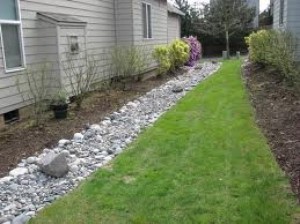
We solve all types of unwanted water problems in and around your home or business. Oklahoma Drainage Provides: Drainage System Installation utilizing French Drains, Surface Drains, Channel Drains, and Sump Pumps
.
If you need a French Drain along an exterior wall, or a surface drain installed in concrete in a sidewalk or driveway, or a sump pump in a basement, we can help. There are literally thousands of specific drain installation applications.
Hard rain and flooding seem to be more common all the time. When I started this business in 1993, having over an inch of rainfall in an hour was pretty extreme. Now having over 4 inch an hour rainfall is not unheard of and is becoming more common.
Protecting our homes and businesses from unwanted water should be a goal for all of us.
Oklahoma Drainage has seen and dealt with virtually every possible Drainage and Standing water problem that can occur in or around your home. With over 2700 Drainage Systems installed since 1993; we have amassed a great deal of experience. This is helpful in seeing underlying problems.
We look for Secondary Water Issues not just the Primary ones. In this business EXPERIENCE TRULY COUNTS!
Hiring your brother- in- law or a Landscape Company to put in your Drainage System is a bad idea. If a landscape company also installs French Drains, you should run!
Why don't they specialize??? Does your Lawyer also do physical therapy?
Some Builders also make bad choices concerning drainage on new homes they are building. New houses should not have problems with water. Builders usually have a landscape company that installs their drains. Sometimes it's a maintenance guy that works for the builder. It's Usually the cheapest fix possible. I've testified in more than one class action lawsuit where a whole housing sub-division had unnecessary Drainage Issues.
Water can cause a huge amount of damage. How important is your money and your home? Over 30% of the work done by Oklahoma Drainage is fixing other people's mistakes. I appreciate the work, but I get frustrated when bad things happen to good people concerning water!
Blane Callen, 405 203 9419
Above is a picture of a French Drain connected to a Channel Drain which connects to a transition pipe. The Transition Pipe takes the water downhill to the exit.
Transition Drainpipe Installation Running Out Through the Curb
Simply Put, a Complex Drainage System has several water sources that comes from different kinds or drains or gutter connections.
Installing Surface Drains
The Complex Drainage System shown above has three Surface Drains connected to one Transition Pipe. It can be one type of drain or several.
Many times, a gutter downspout is connected to a Complex Drainage system too.
Gutter Connected to Drainage System
Complex Drainage System Problem
If you connect too many Drains (Intakes) to a Transition Pipe it will become overwhelmed. A hard rain will cause water to back up and can even cause Vapor Lock which will slow down the water even more. You will definitely experience poor performance.
A Good General Rule.
Most Transition Pipes are 4 inch in diameter. Don’t connect more than 3 Intakes (Drains or Gutter Downspouts) to a 4-inch pipe. If more than 3 intakes need to be connected to the transition pipe, then add a second 4-inch Transition Pipe or use a 6-inch Transition Pipe instead of two 4-inch pipes.
Multiple Drainpipes
The Picture above shows two 6-inch pipes and Three 4-inch pipes. They are all Transition Pipes taking a lot of water to the exit.
Transition Pipes can be ADS which are Black and Flexible or PVC which are white or green and are very rigid.
Notice the white cloth in the picture. This is “Trench Liner.” Its purpose is to keep the gravel clean and to maintain the integrity of the trench. Dirt or sand will soak into the sides of the French Drain if no Trench Liner is used. This occurs underground. On the surface everything will look fine, but over time the Drain will stop working if no Trench Liner is used.
Trench Liner and Pip Filter are very important. They ensure that your French Drain will work well and last a long time.
I Installed a French Drain with trench liner and pipe filter in Norman in 1993. It still works!
French Drains are Designed to handle a higher volume of water than Surface Drains. They can handle broad problem drainage areas that are irregular and would be impossible for a Surface Drain to handle just because water just runs around them and keeps going. French Drains can handle a broad water flow.
They also Intercept Sub-Surface water too!
People don’t realize or think about water flowing across their yard underground. This happens in every yard to some degree. It moves much slower than surface water. Sub-Surface water causes damage to foundations, driveways, and roads. Concrete deteriorates when it stays wet for long periods of time. Even more damage occurs when the water freezes.
French Drains are many times placed across areas that stay wet all the time. Water flows into the gravel of the French Drain laterally underground and are taken to the exit out of the problem area. This keeps foundations and driveways dry. THEY DO A GREAT JOB DRYING OUT THE ENTIRE AREA!
Surface Drains do nothing for Ground Water
A Surface Drain Does absolutely nothing for Sub – Surface water. Wet soil and water below ground are not affected by a surface drain. If you put a Drain Basin with a Grate in the middle of a muddy area with ground water issues, it is a total waste of time and money.
Initially We have a 6 Inch ADS French Drainwith Trench Liner and Pipe Filter Connected to a NDS 4 Inch Channel Drain. Actually, they are not connected. The 6 Inch French Drain Runs under the Driveway and the 4 Inch Channel Drain is Installed on top of It. So, you have a total of 10 Inches of in Drainpipe Diameter. This was necessary because of the huge volume of water running across their yard. The two drains have their own separate outlet pipes. Together they can handle the “River” that runs across their driveway every time it rains hard.
French Drain and Channel Drain Independently running across the Driveway
Gravel Flower Bed with French Drain underneath
French Drain under walkway
Drainscan look great!
A Surface Drainhas a grate that sits on top of a basin. The basin is underground. A Drainpipeis connected underground to an outlet on theDrain Basin. Stormwater Drainsthrough the grate into the Drain Basin. Once in the Drain Basin, water travels out of the basin through a Drainpipe. The Stormwatercontinues downhill in an underground Drainpipeto an exit point.
THIS IS NOT A FRENCH DRAIN!
A Surface Drainmay come in many different shapes or sizes. The Drain Gratemay be round or square. Here is a picture of a common Surface Drain.
Surface Drainand Drainpipe
A Channel Drainis a type ofSurface Drain,and many times is installed in concrete across sidewalks or driveways.
Channel Drain installed in Driveway
Finished Channel DrainFrom the previous picture
Channel Drain
The dirt that was taken out to make the trench is hauled away. It is replaced by some type of small stone or gravel depending on what is desired or available.
Crushed Limestone
I prefer crushed 1 inch limestone. It is the most economical option in my area. Pea Gravel or some other type of small stone can work just as well. The limestone or gravel is placed in the trench on top of the perforated Drainpipeand filled all the way to the surface (ground level). Surface water falls through the gravel and enters the perforated pipe underneath. Sub-Surface water enters the drain underground laterally, flowing into the drainpipe. Water above ground and water below ground is drained away and taken to the exit.
Drainpipe Installation in Edmond
The main downfall of a French Drain is, that they, for the most part isn’t very pretty. They don’t look very nice in a yard once they are completed.
Its ok to let grass grow over the drain. Grass can grow up and through the gravel in the French Drainover time eventually covering the gravel. This is Ok. It won’t have a measurable effect on the performance of the drain.
DON’T COVER THE GRAVEL IN THE FRENCH DRAIN WITH DIRT.
THE DRAIN WON’T WORK IF THE TRENCH IS CLOGGED WITH DIRT. DON’T EVEN INSTALL IT IF YOU ARE GOING TO COVER IT UPWITH DIRT. PUTTING DIRT OVER A FRENCH DRAIN IS LIKE PUTTING A CORK BACK IN A BOTTLE.
DECORATIVE STONE CAN BE USED TO COVER A FRENCH DRAIN AND THEY LOOK GREAT AND LAST A LIFETIME.
Drains can protect your home and property from water damage. Oklahoma Drainage installs a wide variety ofDrains in many different places. A Drain or Group of Drains with Drainpipe going to an exit point is a “Drainage System.”
Drainage Systemscan be made up of one drainor a combination of many drains. Drainage problems can be very complex. Complex Drainage Problems may require a combination of several different types of drains all inter-connected and working together. Other times the drainage problem may be simple and straight-forward requiring only one drain or several of the same type of drainconnected together.
An example of a complex drainage system would be: A French Drainin the back yard connected to a Surface Drain near a flower bed connected to several gutter downspouts, which are connected to a Channel Drain going across a driveway, which is connected to additional Surface Drain in the front yard, which runs to a Curb Fitting that lets all the water drain out on to the street.
1. Keep water away from foundations— A French Drain is best because it can move Surface Water and Sub-Surface Water(water moving under ground) away from the foundation. Many times less experienced companies install Surface Drains to keep water away from foundations. This can be a big mistake. A Surface Drain can’t move or drain Sub-Surface Water.
Surface Drain Restrictions
Also A Surface Drain often can’t move enough water fast enough and easily becomes overwhelmed during a heavy rain. A Surface Drainalso can’t cover or protect a broad enough area. Surface Drains should be designed in a Drainage System to be located in smaller Drainage Areasmoving moderate amounts of water. Surface Drainslook better than French Drains.
Surface Drain Next to a French Drain
If ,”appearance” is more important than Drainage Capacity, Go with the Surface Drain. Just know what you are getting into and what your expectations should be. One side of a foundation alone, can be over 100 feet. A 4 inch or 6 inch French Drain is best when protecting a large area such as a foundation.
2. Keep water away from small or enclosed areas. This might be a low area just through a gate on the side of a house, or the low area between a flowerbed and the wall of a house, or standing water on or near a sidewalk or driveway. These types of Drainage Problems are best served with Surface Drains.
A Surface Draincan move water away from a low area that is relatively small. This can occur in yards, flowerbeds, sidewalks and driveways. A surface Drain is designed to move Surface Wateraway from a problem area to a predetermined exit point. Surface Drains are available in many sizes. How quickly they remove standing water is usually determined by the size of the pipe that is connected to the drain.
Simply put,
a Drainage System is one or a group of underground Drainpipes that take water away from a place that has water standing on it or flowing across it. The water that is in the problem area, can be causing damage or may be inconvenient or both. (Usually Both) A simple Drainage System is a Drain for the water to enter, a Drain Pipe to move the water away from the Drain, and an Exit Point for the water to be released out of the Drain Pipe.
Drainage Systems quickly can become more complicated. Considerations must include:
How does the water get to the problem area?
There may be one or many sources.
Water Sources:
1. It falls from the sky directly
2. It flows down hill over the surface (surface water)
3. It flows underground under the surface (sub-surface water)
4. It flows from the edge of a roof ( There may be many roofs near the problem area, neighbors etc.)
5. It flows from a gutter downspout
6. It flows over the edge of a gutter because the gutter is too small is clogged
7. It flows up from the ground (seeps and springs are common in Oklahoma)
8. It flows from a sprinkler system use ( yours or your neighbors)
There are other reasons for Drainage Problems, the above reasons are just the most common.
Once the number of water sources is determined,
a rough estimate of the amount of water that needs to be drained away on average must be estimated. This can be simplified down to “SMALL, MEDIUM, OR LARGE AMOUNTS OF WATER TO BE DRAINED AWAY. You don’t have to be an engineer trying to calculate fluid dynamics. Experience at diagnosing drainage problems helps however.
How much water needs to be moved will help determine the type and size of the Surface Drainor French Drain that needs to be installed. It also helps to determine the size of Drainpipe required for the Drainage System. A good rule to follow is, “If in doubt, install a larger Drain and Drainpipe.” Unused Drainage Capacity is better than property damage caused by a Drain that is overwhelmed by too much water.
French Drains move more water than Surface Drains —
French Drains move Surface Water and Sub-Surface Water
Surface Drains move Surface Water only
Surface Drains look nicer than French Drains in most cases
Once the type and number of drains is determined and what size Drainpipe will connect them, an exit point must be selected. (Where is the Drainage System going to take the water to and release it?)
The Drainage Curb Fitting
is installed when the desired exit point for the French Drain will release the Drainage Water into the Street. The Drainage Curb Fitting is rectangular in shape and made to be installed through the curb. A small section of Curb is cut out with a concrete saw. The Section is a few inches wider than the Drainage Curb Fitting. We then install new concrete around the curb fitting. Once the concrete has dried, the Drainpipe coming from a French Drain or Surface Drain is connected to the Drainage Curb fitting and then covered with dirt.
is connected to the end of a Drainpipe. It is downhill from a French Drainor a Surface Drain. It is a small release basin with a green pop-up lid. When releasing water, it pops up about an inch to release the water from the French Drain or Surface Drain. When the Storm Water has moved through the Drainage System and out of the Pop-Up Emitter, the green lid closes back to its original closed position. The emitter is designed to release water out into a yard or down a hill or other desirable Drainage Exit Point where there is no curb.
Popup Emitter to release water from a Drainage System in Yukon.
Drainage System installation and design is a big part of our business.
Does your sidewalk turn into a moat after a hard rain?
Does part of your yard look like a pond after a thunderstorm?Worst of all, are you experiencing concrete deterioration to your foundation, sidewalk, or driveway.
Oklahoma Drainage can design a Drainage System to solve your Drainage Problems. Our Drainage Systems can be simple or complex.We utilize, French Drains, Surface Drains, Channel Drains, Basin Drains, Basement Drains, Trench Drains, and Sump Pumps. Estimates are free!
Large 6 Inch French Drain Installed in Norman
Just what is a “French Drain?” Many times, people incorrectly
use the phrase, “French Drain,” to apply to many different types of Drains that could be used in a Drainage System. The term is widely used and many times incorrectly connected to “Surface Drains,” or “Channel Drains.”
A Surface Drain
has a grate that sits on top of a basin. The basin is underground. A Drainpipe is connected underground to an outlet on the Drain Basin. Stormwater Drains through the grate into the Drain Basin. Once in the Drain Basin, water travels out of the basin through a Drainpipe. The Stormwater continues downhill in an underground Drainpipe to an exit point.
Surface Drain Installed next to sidewalk in Oklahoma City.
A Surface Drain may come in many different shapes or sizes. It is a Drain Basin with a Drain Grateon top and a Drainpipe connected on the side. The Drain Grate may be round or square.
is a type of Surface Drain, and many times is installed in concrete across sidewalks or driveways. It is long and narrow with a grate on top.
A French Drain is completely different from a Surface Drain. A basic French Drain consists of a Perforated Drainpipe in the bottom of a trench. A Trench Liner is sometimes used depending on the Drainage System Design and the type of soil. The Drainpipe should have a neoprene sock around the Perforated Drainpipe. This is to ensure that the Drainpipe does not become clogged.
6 Inch French Drain Installation
A trench is dug that is slightly wider than the French Drainpipe that is being used. There are several sizes. Three Inch, Four Inch, and Six Inch are the most common sizes of French drain Pipe.
The dirt that is taken out to make the trench is hauled away. It is replaced by some type of small stone or gravel depending on what is desired or available. I prefer crushed 1 inch lime stone. It is the most economical option in my area. Pea Gravel or some other type of small stone can work just as well.
The limestone or gravel is placed in the trench on top of the perforated Drainpipe and filled all the way to the surface (ground level). In some cases where the French Drain needs to be deep or is being placed in sandy soil, a special trench liner must be placed in the trench before the perforated Drainpipe or the Gravel are installed. This helps maintain the integrity of the trench over time. It also increases the cost of the French Drain and the amount of time to install it. I install a trench liner in a French Drain.
is designed to handle a large volume of water and cover a large area. The Drain is anyplace the trench goes. It has many applications and can be used in many situations. It can be installed by itself or incorporated into a Drainage System with Surface Drains or Gutter Downspouts connected to it.
The main downfall of a French Drain is that they, for the most part isn’t very pretty. They don’t look very nice in a yard once they are completed.
Depending on the area the French Drain is installed and the type of grass around the French Drain, will dictate whether grass grows over the lime stone. Grass can grow up and through the gravel in theFrench Drain over time eventually covering the gravel.
This is OK. It won’t have a measurable effect on the performance of the drain.
DONT COVER THE GRAVEL IN THE FRENCH DRAIN WITH DIRT. THE FRENCH DRAIN WON’T WORK IF THE TRENCH IS CLOGGED WITH DIRT. DON’T EVEN INSTALL IT IF YOU ARE GOING TO COVER IT UP WITH DIRT.
DECORATIVE STONE CAN BE USED TO COVER A FRENCH DRAIN AND THEY LOOK GREAT A
A Surface Drain often can’t move enough water fast enough and easily becomes overwhelmed during a heavy rain. A Surface Drainalso can’t cover or protect a broad enough area.
If, “appearance” is more important than Drainage Capacity, Go with the Surface Drain. Just know what you are getting into and what your expectations should be. One side of a foundation alone, can be over 100 feet. A 4 inch or 6-inch French Drain is best when protecting a large area such as a foundation.
Keep water away from small or enclosed areas. This might be a low area just through a gate on the side of a house, or the low area between a flowerbed and the wall of a house or standing water on or near a sidewalk or driveway. These types of Drainage Problemsare best served with Surface Drains.
A Surface Drain can move water away from a low area that is relatively small. This can occur in yards, flowerbeds, sidewalks and driveways.
A Surface Drain is designed to move Surface Wateraway from a problem area to a predetermined exit point. Surface Drains are available in many sizes. How quickly they remove standing water is usually determined by the size of the Drainpipe that is connected to the Drain.
Channel Drain Installation Is a Central Focus for Oklahoma Drainage. We have been Installing Channel Drains set in Concrete since 1993.
Channel Drains can look great and be very functional and durable.
Channel Drain Installed in Driveway
However, A Channel Drain is not an easy thing to install! It takes a great deal of precision, Experience, and Attention to Detail. This is Definitely Not something to allow your Landscape Company to attempt, or your Brother-In-Law!
Just because someone is skilled at pushing a mower around, doesn’t mean you should let them cut across your driveway with a concrete saw.
I get a lot of business fixing and replacing Drains of all types that were installed incorrectly by landscape companies and armatures. Typically, they stick to messing up French Drains, but I have fixed Channel Drains that were an absolute “Train Wreck!” as well.
In 1993 we had no website. I stuck little signs on the side of the road as advertisement. I got my first Drain Installation work in March of 1993 in Norman. It was in Brookhaven North of Robinson Street on the West side of I 35.
The majority of our customers live in Oklahoma City, Norman, Edmond, Yukon, Mustang, Moore, Midwest City, Del City, Blanchard, New Castle, Yukon and Choctaw.
Oklahoma Drainage and Sprinkler Repair hasn’t been limited to those areas, however. We have also installed French Drains, Surface Drains, Channel Drains, and Sump Pumps in many other cities.
Working Drainage Systems Installed by Oklahoma Drainage also reside in: Lawton, Duncan, Ardmore, Chickasha, Shawnee, Enid, Weatherford, Elk City, El reno and many other places.
If you live in any of these Cities or towns, we have installed a French Drain, Surface Drain, Channel Drain, or Sump Pump within 5 miles of your home.
Trench Liner and Pipe Filter Installed with French Drain
Here is a description of other recent work.
A little bit North of Downtown Oklahoma City, OklahomaDrainage installed a 6-inch French Drain between two businesses which were less than three feet apart. The French Drain went between a Law Firm and a Tire shop. Water was leaking through the walls of both businesses. Gutters between the two establishments were dumping a huge amount of water. We installed a 6-inch French Drain between the gutters.
It took a long time to get the dirt out of the trench for the French Drain. It was a very tight fit. We had to use a little red wagon to haul out the dirt for the French Drain and haul back in the crushed limestone for the French Drain. It looked a little silly, but it was the only thing we could find that was narrow enough to fit between the buildings. A French Drain that normally would take 1 day to install took three.
We also have fixed a broken Sprinkler Pipe or Two. Seems like a million. Ok, not that many.
I wonder how many? A lot!!!!
Oklahoma Drainage and Sprinkler Repair provides Service for all of Central Oklahoma Including: Oklahoma City, Norman, Edmond, Moore, Yukon and Mustang.
IT MAY TAKE A FEW HOURS FOR US TO GET THERE BUT WE WILL COME TO HELP.
One Common problem is that they continue to run and won’t shut off. In most cases this is a problem with a sprinkler valve that has “Stuck” in the on position.
This can be temporarily solved by shutting of the Emergency Shutoff Valve. The problem is that some sprinkler systems don’t have one to turn off or if they do the homeowner doesn’t know where it is.
It may be on the back-flow valve which may be located on the side of the house under a big plastic fake rock.
Many sprinkler systems in Oklahoma have them. (50 % ?) Under the plastic rock is a back-flow valve with two shut off handles. Usually, they have blue or green or tan handles. Turn one of the handles and it should shut off the water to your sprinkler system.
Other times the Emergency Shutoff Valve is in a box in the ground out by the curb near your water meter. The valve box will have a green lid. Sometimes they are difficult to open. Many times, I had to pry them open with a flat head screwdriver.
Oklahoma Drainage and Sprinkler Repair Provides Service for Back-Flow-Valves and all types of Lawn Sprinkler Repair and Service. We have provided Expert Service for all of Central and Western Oklahoma Since 1993.
Back-Flow-Valves
There are two types of Back-Flow-Valves.
Above Ground
Above Ground Back-Flow-Valve.
Below Ground Back-Flow-Valve.
Below Ground Back-Flow-Valve
What is a Back-Flow-Valve?
A Back-Flow-Valve is a part of a Lawn Sprinkler System. Water passes through it from the water source which can be a Water Meter or a Well Pump. It forces water to travel in only one direction from the source to the sprinkler system. It can’t travel backward back to the water source which again is a water meter or well pump.
A Back-Flow-Valve provides protection to the water source from back pressure and chemical contamination from lawn fertilizer.
Most Cities require a Back-Flow-Valve as “Code” for Sprinkler Installation.
Emergency Shut off
Back-Flow-Valves usually have an Emergency Shutoff valve on them that can shut off the water to the lawn sprinkler system but keep the water turned on to the home. Most Back-Flow-Valves have two Emergency Shut off Handles. Either one will work. Many times, they are hard to turn, however.
If there is a leak or water is shooting up in the air just turn the valve handle and give us a call.
Norman Sprinkler Checkup is a Central Focus for Oklahoma Drainage. We Performed or first Sprinkler Repair in Norman in 1993. It was in Brookhaven on the West side of Norman.
Recently we had a customer in Oklahoma City who wanted to move his Sprinkler Valves. They were in a bad place in his flower bed. He wanted to plant a tree where the valves were located.
We moved 4 Sprinkler Valves about feet out into the yard. All the Sprinkler Pipes had to be redesigned and installed matching the new location and maintaining full functionality.
Inside the valve box is a plastic handle that can turn off the water to the sprinkler system. It can be blue or red or grey in color.
Many times, the valve box will be full of dirt, and you can’t turn or even see the handle until some of the dirt has been dug out by hand.
French Drain Design must take into account many variables. One consideration for a French Drain is Soil Type. French Drain Design must take into account the type of soil that the French Drain runs through. If the soil is “Tight or made up of Clay, A French Drain Liner may not be necessary.
When a French Drain, Is Installed in sandy soil, A Trench Liner is always needed. As a result the French Drain Gravel stays clean.
The Gravel or Limestone that is used to fill the French Drain trench may be all that is needed to maintain the integrity of the trench over time. This means that dirt will not mix in with the French Drain Gravel and clog it up over time. This is not the case however if your soil is sandy or loose.
A Trench Linershould be used to prevent this type of soil from moving into the gravel of the French Drain. Trench Linersare relatively inexpensive and are not hard to install. If you are not sure what to do then install the Trench Liner in the French Drain.
Recently we installed a 4-inch French Drain with Trench Linerand Pipe Filter in West Norman on Harrogate Street. Our customer had a heavy water build up area on the side of her house. Water would pool up during a rain and sink down into her flower bed. Once the slab and foundation of the house got very wet, the water would seep into the floor ducts for their Central Heat and Air unit. This is bad for several reasons.
A wet foundation causes deterioration of the cement. Cracks can occur leading to all sorts of other problems.
Oklahoma Drainage Installed 4 Inch French Drain with trench liner and pipe filter about one foot away from the wall where all the water was standing and penetrating the Duct Work. The French Drain ran parallel to the house for 60 Feet. At that point the French Drain transitioned to 4 Inch solid ADS Drain Pipe and continued South an additional 80 feet to a Curb Outlet installed at the street.
Curb Outlet
We cut the curb and installed a Curb Outlet With Acrylic Concrete to make it look nice and last without chipping.
Along the course of the French Drain, we also connected 2 Gutter Down Spouts Directly into the French Drain..
This provides more efficient movement of the storm water to the exit, but also creates suction in the French Drain behind it.
This is called the “Bernoulli Effect.” If you remember your High School Science Class.
Oklahoma Drainage has used these simple concepts many times to provide a solution to the above problem.
Water still had to be vacuumed out of the Duct Work. But Future water was and is kept out of the Duct Work and Floor Vents. Also, the Foundation Stays Dry. No mold or foundation Break Down.
Determining the size of the French Drain Pipe can be difficult. If the French Drain is not very big and has no Gutter Down-Spouts or Surface Drains connected to it then 3 inch or 4 inch French Drainpipe may be used. If the French Drain is large or has many gutters or Surface Drains connected into it, then you should use 6 Inch French Drainpipe or larger.
Just what is a “French Drain?” Many times, people incorrectly use the phrase, “French Drain,” when they mean “Surface Drain” or “Channel Drain.”
A basicFrench Drain
consists of aPerforated Drainpipe in the bottom of a trench. The French Drain Trench runs through a Problem Drainage Areathat needs to be drained. The French Drainpipe is perforated (Full of Small Holes) and has Neo-Prene Soc around the pipe. This soc helps prevent debris from clogging the French Drainpipe. The dirt that was taken out to make the trench is hauled away. It is replaced by some type of small stone or gravel depending on what is desired or available. I prefer crushed 1 inch limestone.
It is the most economical option in my area. Pea Gravel or some other type of small stone can work just as well. The limestone or gravel is placed in the trench on top of the perforated Drainpipe and filled all the way to the surface (ground level).
Oklahoma Drainage recently diagnosed a Drainage Problem in South Oklahoma City. The Homeowner had a Deep French Drain down along the Stem wall of the house. The French Drainpipe was cheap and had collapsed. We brought in a Mini Excavator.
in their basement that was fed from a French Drain outside the Basement Wall. The French Drain was 14 feet down. We used and Excavator and dug up the pipe and replaced it with Durable ADS 4 inch perf/soc French Drainpipe. In the end, we were able to dig up the pipe and replace it.
Next, we installed a new exit for the water by installing a curb fitting. No more flooding in the customers basement. A few weeks later our customer was able to lay carpet in the basement with no problems.
Oklahoma Drainage has been diagnosing and solving Drainage Problems since 1993.
As a result, we have gained a tremendous amount of experience.
Water has the ability to get into places around your home where you really don’t want it to be. This is never a good thing! Some drainage problems are easy to solve. Typically, water enters the problem drainage area one way from one source. The really tricky drainage problemsoccur when water enters the problem drainage area from multiple directions and from multiple sources. Sometimes a secondary water source can’t be seen or identified until the primary water problem source is eliminated.
Think About
You have to think about all the possible ways water can get into the problem area. Sometimes it is obvious. Sometimes its hard to determine all the possible water sources.
French Drain Installed along and under walkway to pool.
A drainage systemis installed with a surface drainas the “intake” with drainage pipe running to an exit point. Initially the water drains away and everything looks great. The next day water is back and is all around the surface drain, but below the edge and it hasn’t rained at all, so no additional water ran over the surface of the ground to flood the area.
The primary water source was solved, ( The surface water run off ) but the secondary water source was not. Which was sub-surface water, (ground water) running into the area. A surface drain can’t drain “ground water.” A French Drain should have initially been installed instead of a Surface Drain. A French Drain can drain both Surface Water and Ground Water.
Moore Oklahoma Surface Drain, Sprinkler Repair are services provided by Oklahoma Drainage and Sprinkler Repair since 1993. We service all of Central and Western Oklahoma.
Moore Oklahoma French Drain
My name is Blane Callen. I own and operate Oklahoma Drainage. Oklahoma Drainage has been solving water problems for home owners and small business in central Oklahoma since 1993. We install French Drains, Surface Drains, Sump Pumps and Sod.
Drainage Systemscan be made up of one drain or a combination of many drains. Drainage problems can be very complex. Complex Drainage Problemsmay require a combination of several different types of drains all inter-connected and working together. Other times the drainage problemmay be simple and straight-forward requiring only one drain or several of the same type of drain connected together.
An example of a complex drainage system would be: A French Drain in the back yard connected to a Surface Drain near a flower bed connected to several gutter downspouts, which are connected to a Channel Drain going across a driveway, which is connected to additional Surface Drain in the front yard, which runs to a Curb Fittingthat lets all the water drain out on to the street.
Curb Outlet
Simple Drainage System
A simple Drainage System might consist of a Surface Drain that is connected to a second Surface Drain which runs to a Pop-up Emitterwhich lets water drainover the curb and into the street.
An “Exit Point” is the term used for where all the water leaves theDrainage System. Determining the Exit Point is very critical. It is one of the first things we do when diagnosing a Drainage Problem.
Intake, Transition, and Exit are the parts of a Drainage System.
They can:
1. Keep water away from foundations— A French Drain is best because it can move Surface Water and Sub-Surface Water(water moving under ground) away from the foundation. Many times less experienced companies install Surface Drains to keep water away from foundations. This can be a big mistake.
A Surface Drain can’t move or drain Sub-Surface Water. Also A Surface Drainoften can’t move enough water fast enough and easily becomes overwhelmed during a heavy rain. A Surface Drainalso can’t cover or protect a broad enough area.
If ,”appearance” is more important than Drainage Capacity, Go with the Surface Drain. Just know what you are getting into and what your expectations should be. One side of a foundation alone, can be over 100 feet. A 4 inch or 6 inch French Drain is best when protecting a large area such as a foundation.
2. Keep water away from small or enclosed areas. This might be a low area just through a gate on the side of a house, or the low area between a flowerbed and the wall of a house, or standing water on or near a sidewalk or driveway. These types of Drainage Problems are best served with Surface Drains.
Small Area
ASurface Drain can move water away from a low area that is relatively small. This can occur in yards, flowerbeds, sidewalks and driveways. A Surface Drain is designed to moveSurface Water away from a problem area to a predetermined exit point. Surface Drains are available in many sizes. How quickly they remove standing water is usually determined by the size of the Drain Pipe that is connected to the Drain.
Don’t let standing water or storm water run-off damage your home! We can helpDrainage Problems in and around your home or business.
Is water in a bad Place?
If you have water standing in the wrong place after a hard rain, a French Drain can be a great solution! If your sidewalk turns into a moat after a storm, or if your back yard floods from run-off from your neighbor’s roof give us a call.
Drainage Systems can be made up of one drain or a combination of many drains. Drainage problems can be very complex. Complex Drainage Problems may require a combination of several different types of drains all inter-connected and working together. Other times the drainage problem may be simple and straight-forward requiring only one drain or several of the same type of drain connected together.
An example of a complex drainage system would be: A French Drain in the back yard connected to a Surface Drain near a flower bed connected to several gutter downspouts, which are connected to a Channel Drain going across a driveway, which is connected to additional Surface Drain in the front yard, which runs to a Curb Fitting that lets all the water drain out on to the street.
A simple Drainage System
might consist of a Surface Drain that is connected to a second Surface Drain which runs to a Pop-up Emitter which lets water drain over the curb and into the street.
An “Exit Point” is the term used for where all the water leaves the Drainage System. Determining the Exit Point is very critical. It is one of the first things we do when diagnosing a Drainage Problem.
French Drain and Surface Drain
Drainage Systems can:
1. Keep water away from foundations— A French Drain is best because it can move Surface Water and Sub-Surface Water(water moving underground) away from the foundation. Many times less experienced companies install Surface Drains to keep water away from foundations. This can be a big mistake. A Surface Drain can’t move or drain Sub-Surface Water.
Also
A Surface Drain often can’t move enough water fast enough and easily becomes overwhelmed during a heavy rain. A Surface Drainalso can’t cover or protect a broad enough area. Surface Drains should be designed in a Drainage System to be located in smaller Drainage Areas moving moderate amounts of water. Surface Drains look better than French Drains. If ,”appearance” is more important than Drainage Capacity, Go with the Surface Drain. Just know what you are getting into and what your expectations should be. One side of a foundation alone, can be over 100 feet. A 4 inch or 6 inch French Drain is best when protecting a large area such as a foundation.
2. Keep water away from small or enclosed areas. This might be a low area just through a gate on the side of a house, or the low area between a flowerbed and the wall of a house, or standing water on or near a sidewalk or driveway. These types of Drainage Problems are best served with Surface Drains. A Surface Drain can move water away from a low area that is relatively small. This can occur in yards, flowerbeds, sidewalks and driveways. A surface Drain is designed to move Surface Water away from a problem area to a predetermined exit point. Surface Drains are available in many sizes. How quickly they remove standing water is usually determined by the size of the pipe that is connected to the drain.
Simply put,
a Drainage System is one or a group of underground Drain Pipes that take water away from a place that has water standing on it or flowing across it. The water that is in the problem area, can be causing damage or may be inconvenient or both. (Usually Both) A simple Drainage System is a Drain for the water to enter, a Drain Pipe to move the water away from the Drain, and an Exit Point for the water to be released out of the Drain Pipe.
Drainage Systems quickly can become more complicated. Considerations must include:
How does the water get to the problem area? There may be one or many sources.
Water Sources:
1. It falls from the sky directly
2. It flows down hill over the surface (surface water)
3. It flows underground under the surface (sub-surface water)
4. It flows from the edge of a roof ( There may be many roofs near the problem area, neighbors etc.)
5. It flows from a gutter downspout
6. It flows over the edge of a gutter because the gutter is too small is is clogged
7. It flows up from the ground (seeps and springs are common in Oklahoma)
8. It flows from a sprinkler system use ( yours or your neighbors)
9. It flows from a leaking pipe ( water mains, water meters, water lines, sprinkler pipes, sprinkler valves)
There are other reasons for Drainage Problems,
the above reasons are just the most common.
Once the number of water sources is determined, a rough estimate of the amount of water that needs to be drained away on average must be estimated. This can be simplified down to “SMALL, MEDIUM, OR LARGE AMOUNTS OF WATER TO BE DRAINED AWAY. You don’t have to be an engineer trying to calculate fluid dynamics. Experience at diagnosing drainage problems helps however.
How much water needs to be moved will help determine the type and size of the Surface Drainor French Drain that needs to be installed. It also helps to determine the size of Drainpipe required for the Drainage System. A good rule to follow is, “If in doubt, install a larger Drain and Drain Pipe.” Unused Drainage Capacity is better than property damage caused by a Drain that is overwhelmed by too much water.
For home and small business use typical materials used are:
6 inch, 9 inch, and 12 inch Surface Drains –
3 inch, 4 inch, and 6 inch Drain Pipes —
3 inch, 4 inch, and 6 inch French Drains —
French Drains move more water than Surface Drains —
Surface Drains look nicer than French Drains in most cases
Once the type and number of drains is determined
and what size Drainpipe will connect them, an exit point must be selected. (Where is the Drainage System going to take the water to and release it?)
The Drainage Curb Fitting is installed when the desired exit point for the French Drain will release the Drainage Water into the Street. The Drainage Curb Fitting is rectangular in shape and made to be installed through the curb. A small section of Curb is cut out with a concrete saw. The Section is a few inches wider than the Drainage Curb Fitting. We then install new concrete around the curb fitting. Once the concrete has dried, the Drainpipe coming from a French Drain or Surface Drain is connected to the Drainage Curb fitting and then covered with dirt.
The Drainage Pop-Up Emitter
is connected to the end of a Drainpipe. It is downhill from a French Drainor a Surface Drain. It is a small release basin with a green pop-up lid. When releasing water, it pops up about an inch to release the water from the French Drain or Surface Drain. When the Storm Water has moved through the Drainage System and out of the Pop-Up Emitter, the green lid closes back to its original closed position. The emitter is designed to release water out into a yard or down a hill or other desirable Drainage Exit Point where there is no curb.
Drainage System installation and design is a big part of our business. Does your sidewalk turn into a moat after a hard rain?Does part of your yard look like a pond after a thunderstorm?Worst of all, are you experiencing concrete deterioration to your foundation, sidewalk, or driveway.
Oklahoma Drainage can design a Drainage System to solve your Drainage Problems. Our Drainage Systems can be simple or complex.We utilize, French Drains, Surface Drains, Channel Drains, Basin Drains, Basement Drains, Trench Drains, and Sump Pumps. Estimates are free!
French Drain Installation, Surface Drain Installation, Drainage System Installation
Sprinkler Repair for all aspects of Residential Sprinkler Systems
Channel Drain in Oklahoma City
Recently we solved a problem for some folks in Oklahoma City. They had a pond on their sidewalk in front of their home every time it rained. We installed a Channel Drain in the Sidewalk to solve the Drainage Problem as shown in the Picture above.
Sprinkler Repair Service — Drainage Systems — French Drains — Surface Drains— Sump Pumps — Scheduled Sprinkler Repair
Drainage Systemshave been a big part of our business for the last 33 years. Those years have provided us with the necessary expertise to provide solutions for a wide variety of Drainage Problems. Storm Water Run-Offcauses damage to Foundations, Sidewalks, Driveways, Trees, Plants and Grass. A Drainage SystemInstalled by Oklahoma Drainage and Sprinkler Repair can help protect your valuable property.
Harsh weather
inOklahoma seems to becoming more common. In 2019, Norman Oklahoma had 4 inches of rain in two hours. That’s the most rain in a short time that I can remember. Storm-Water runoffcan cause damage to all types of property and buildings. Water getting inside your house is never a good thing. A Drainage System that utilizes a French Drain can help.
Drains can protect your home and property from water damage. We install a wide variety of Drains in many different places. A Drain or Group of Drains with Drainpipe going to an exit point is a “Drainage System.”
Drainage Systems can be made up of one drain or a combination of many drains. Drainage problems can be very complex. Complex Drainage Problems may require a combination of several different types of drains all inter-connected and working together. Other times the drainage problem may be simple and straight-forward requiring only one drain or several of the same type of drain connected together.
Complex Drainage System
An example of a complex drainage system would be: A French Drain in the back yard connected to a Surface Drain near a flower bed connected to several gutter downspouts, which are connected to a Channel Drain going across a driveway, which is connected to additional Surface Drain in the front yard, which runs to a Curb Fittingthat lets all the water drain out on to the street.
A simple Drainage System might consist of a Surface Drain that is connected to a second Surface Drain which runs to a Pop-up Emitter which lets water drain over the curb and into the street.
An “Exit Point” is the term used for where all the water leaves the Drainage System. Determining the Exit Point is very critical. It is one of the first things we do when diagnosing a Drainage Problem.
Drainage Systems can:
1. Keep water away from foundations— A French Drain is best because it can move Surface Water and Sub-Surface Water(water moving under ground) away from the foundation. Many times less experienced companies install Surface Drains to keep water away from foundations. This can be a big mistake. A Surface Drain can’t move or drain Sub-Surface Water. Also A Surface Drain often can’t move enough water fast enough and easily becomes overwhelmed during a heavy rain. A Surface Drainalso can’t cover or protect a broad enough area.
Surface Drains should be designed in a Drainage System to be located in smaller Drainage Areas moving moderate amounts of water. Surface Drainslook better than French Drains. If ,”appearance” is more important than Drainage Capacity, Go with the Surface Drain. Just know what you are getting into and what your expectations should be. One side of a foundation alone, can be over 100 feet. A 4 inch or 6 inch French Drain is best when protecting a large area such as a foundation.
Surface Drain Installed next to sidewalk in Oklahoma City.
2. Keep water away from small or enclosed areas. This might be a low area just through a gate on the side of a house, or the low area between a flowerbed and the wall of a house, or standing water on or near a sidewalk or driveway. These types of Drainage Problems are best served with Surface Drains. A Surface Drain can move water away from a low area that is relatively small. This can occur in yards, flowerbeds, sidewalks and driveways.
A Surface Drain
is designed to move Surface Water away from a problem area to a predetermined exit point. Surface Drains are available in many sizes. How quickly they remove standing water is usually determined by the size of the Drainpipe that is connected to the Drain.
Many Folks don’t know the difference. Actually, there are many differences and a few similarities. One difference is, a French Drain takes in a larger amount of water into the drainpipe than a Surface Drain. There are advantages to Surface Drains as well.
Servicing all of Central and Western Oklahoma since 1993.
Oklahoma Drainage recently diagnosed a Drainage Problem in South Oklahoma City. The Homeowner had a sump Pump in their basement that was fed from a French Drain outside the Basement Wall. The French Drain was 14 feet down along the Stem wall of the house. The French Drainpipe was cheap and had collapsed. We brought in a Mini Excavator and dug up the pipe and replaced it with Durable ADS 4 inch perf/soc French Drainpipe. In the end, we were able to dig up the pipe and replace it.
Many different types of Drains can be hooked together by one Drainpipe. The Drainpipe then running to an Exit Pointmakes up a Drainage System. One common type of Drain used in a Drainage System is A “French Drain.” Many times a French Drain is installed close to a building foundation or in a low area next to a home or business.
A Surface Drain often can’t move enough water fast enough and easily becomes overwhelmed during a heavy rain. A Surface Drainalso can’t cover or protect a broad enough area.
If, “appearance” is more important than Drainage Capacity, Go with the Surface Drain. Just know what you are getting into and what your expectations should be. One side of a foundation alone, can be over 100 feet. A 4 inch or 6-inch French Drain is best when protecting a large area such as a foundation.
Keep water away from small or enclosed areas. This might be a low area just through a gate on the side of a house, or the low area between a flowerbed and the wall of a house or standing water on or near a sidewalk or driveway. These types of Drainage Problemsare best served with Surface Drains.
A Surface Drain can move water away from a low area that is relatively small. This can occur in yards, flowerbeds, sidewalks and driveways.
A Surface Drain is designed to move Surface Wateraway from a problem area to a predetermined exit point. Surface Drains are available in many sizes. How quickly they remove standing water is usually determined by the size of the Drainpipe that is connected to the Drain.
However, A Channel Drain is not an easy thing to install! It takes a great deal of precision, Experience, and Attention to Detail. This is Definitely Not something to allow your Landscape Company to attempt, or your Brother-In-Law!
Just because someone is skilled at pushing a mower around, doesn’t mean you should let them cut across your driveway with a concrete saw.
I get a lot of business fixing and replacing Drains of all types that were installed incorrectly by landscape companies and armatures. Typically, they stick to messing up French Drains, but I have fixed Channel Drains that were an absolute “Train Wreck!” as well.
French Drain Installation — French Drains are designed to do a lot of things. If you have an area that has unwanted water standing in it or running across it, a French Drain can be the answer.
A French Drain is a trench that runs across the Drainage Problem Area. A French Drainpipe is placed in the bottom of the trench. TheFrench Drainpipe is perforated with thousands of small holes. In most cases the Drainpipehas a nylon soc around the pipe to act as a filter for the French Drain.
The French Drain trench is then filled with some type of small rock or stone. We typically use crushed 1 inch Limestone to cover the French Drainpipe. The dirt that was dug out of the trench is taken away or spread out around the French Drain. The Limestone replaces the dirt and fills the French Drain Trench all the way to the surface.
When water come in contact with theFrench Drain, it seeps down through the stones and into the French Drainpipe. It then flows through the Drainpipe to the exit point. Typically, aFrench Drain will have two possible exit points. The First is called a “Pop-Up Emitter.” It is a Green Lid on top of a release basin for the French Drain.
What is the primary source of water coming into the problem drainage area.
Are there secondary sources of water entering the area.
What are they and how many.
How fast does water enter the area and how often.
What are the potential exit points for the water, Where do we want to take the water too. Is there more than one potential exit point to increase drainage capacity.
Oklahoma Drainage recently diagnosed a Drainage Problem in South Oklahoma City. The Homeowner had a sump Pump in their basement that was fed from a French Drain outside the Basement Wall.
The French Drain was 14 feet down along the Stem wall of the house. The French Drainpipe was cheap and had collapsed. We brought in a Mini Excavator and dug up the pipe and replaced it with Durable ADS 4 inch perf/soc French Drainpipe. In the end, we were able to dig up the pipe and replace it.
a French Drain is used to protect a broad area that has a lot of standing water. A French Drain might run alongside a home’s foundation, or beside a driveway, or on any Drainage Project where Sub-Surface water is the primary problem. If water is running toward your home underground (through sandy soil), A French Drain is the only Solution for draining away water flowing underground.
6 Inch French Drain
If you live in Oklahoma Cityand need a French Drain installed in your yard, or along your driveway, or near your foundation, give us a call.
If you live in Edmond or Norman and need a Surface Drain installed in the concrete in your sidewalk or driveway, we can help. If you live in Mustang or Yukon and would like to protect your trees or flower beds from standing water with a French Drain, Oklahoma Drainage specializes in just that!
Oklahoma Drainage and Sprinkler Repair
Servicing Central Oklahomaincluding Oklahoma City,Norman,Edmond, Midwest City,Del City,Yukon, Mustang, Moore, Norman,Purcell,Newcastle, Blanchard and surrounding areas. For an additional charge we will travel outside Central Oklahoma. We have installed a Drainage Systems as far away as Ardmore, Altus, or Tulsa.
This is a great place for a French Drain!
Central Oklahoma thunderstorms can cause damage! Every time it rains, Do you have water standing in the wrong place? Does Stormwater runoff leave water standing on your driveway, sidewalk, backyard, flowerbed, or one of many low spots in your yard? WE can help!
We can quickly diagnose your drainage problems and design a solution through the use of one or several kinds or drains in combination.
Servicing all of Central and Western Oklahoma since 1993.
Oklahoma Drainage recently diagnosed a Drainage Problem in South Oklahoma City. The Homeowner had a sump Pump in their basement that was fed from a French Drain outside the Basement Wall. The French Drain was 14 feet down along the Stem wall of the house. The French Drainpipe was cheap and had collapsed. We brought in a Mini Excavator and dug up the pipe and replaced it with Durable ADS 4 inch perf/soc French Drainpipe. In the end, we were able to dig up the pipe and replace it.
Many Folks don’t know the difference. Actually, there are many differences and a few similarities. One difference is, a French Draintakes in a larger amount of water into the drain Pipe than a Surface Drain. There are advantages to Surface Drains as well.
Many different types of Drains can be hooked together by one Drainpipe. The Drainpipe then running to an Exit Point makes up a Drainage System.
One common type of Drain used in a Drainage System is A “French Drain.” Many times, a French Drain is installed close to a building foundation or in a low area next to a home or business. This puts the French Drain in close proximity to Gutter Down Spouts.
Rather than have water come off the roof and out the Down Spout and on to the ground below, many times it is much better to tie a Gutter Down Spout Directly into a French Drain or nearby Drainpipe depending on the Drainage SystemDesign.
Connecting The Down Spouts
Directly into a French Drain is much more efficient and causes suction to occur in the French Drain. Connection of Gutter Down Spoutsto a French Drain makes the Drainage System work better.
Do you have water standing in your yard after a hard rain? Does your sidewalk become a moat during a thunder-storm? Is standing water causing your foundation to deteriorate and break down? Is water seeping into your home and causing mold?
Stormwater run off
can cause many types of problems. Oklahoma Drainage can diagnose your drainage issues and design a Drainage System to fit your specific needs. We install many types of drains including French Drains, Channel Drains, Surface Drains, Basin Drains, Trench Drains, Basement Drains, and Sump Pumps.
Many times, people incorrectly use the phrase, “French Drain,” when they mean “Surface Drain” or “Channel Drain.”
A basic French Drainconsists of a Perforated Drainpipe in the bottom of a trench. The French DrainTrench runs through a Problem Drainage Areathat needs to be drained. The French Drainpipe is perforated (Full of Small Holes) and has Neo-Prene Soc around the pipe. This soc helps prevent debris from clogging the French Drainpipe.
The dirt that was taken out to make the trench is hauled away. It is replaced by some type of small stone or gravel depending on what is desired or available. I prefer crushed 1 inch limestone.
Crushed Limestone
It is the most economical option in my area. Pea Gravel or some other type of small stone can work just as well.
The limestone or gravel is placed in the trench on top of the perforatedDrainpipeand filled all the way to the surface (ground level). In some cases where theFrench Drainneeds to be deep or is being placed in sandy soil, a special trench liner must be placed in the trench before the perforated Drainpipe or the Gravel are installed.
This helps maintain the integrity of the trench over time. It also increases the cost of theFrench Drainand the amount of time to install it. I install a trench liner in aFrench Drain Every time.
A French Drain
is designed to handle a large volume of water and cover a large area. The Drain is anyplace the trench goes. It has many applications and can be used in many situations. It can be installed by itself or incorporated into a Drainage System with Surface Drains or Gutter Down-Spouts connected to it.
The main downfall of a French Drain
is that they, for the most part isn’t very pretty. They don’t look very nice in a yard once they are completed.
Depending on the area the French Drain is installed and the type of grass around theFrench Drain, will dictate whether grass grows over the limestone. Grass can grow up and through the gravel in theFrench Drainover time eventually covering the gravel. This is Ok. It won’t have a measurable effect on the performance of the drain.
DON’T COVER THE GRAVEL IN THEFRENCH DRAIN WITH DIRT. THE FRENCH DRAINWON’T WORK IF THE TRENCH IS CLOGGED WITH DIRT. DON’T EVEN INSTALL IT IF YOU ARE GOING TO COVER IT UP WITH DIRT.
DECORATIVE STONE CAN BE USED TO COVER AFRENCH DRAIN AND THEY LOOK GREAT AND LAST A LIFETIME.
Drainage Systems
can be made up of one drain or a combination of many drains. Drainage problems can be very complex. Complex Drainage Problems may require a combination of several different types of drains all inter-connected and working together. Many times, aFrench Drain, might be connected to a Surface Drain, which then could be connected to another French Drain. Other times the drainage problem may be simple and straight-forward requiring only one drain or several of the same type of drain connected together.
Cutting The Curb forFrench Drain Outlet
An example of a complex drainage system would be:
A French Drain in the back yard connected to a Surface Drain near a flower bed connected to several gutter downspouts, which are connected to a Channel Drain going across a driveway, which is connected to additional French Drainin the front yard, which runs to a Curb Fitting that lets all the water drain out on to the street.
A simple Drainage System might consist of a French Drain which runs to a Pop-up Emitter which lets water drain over the curb and into the street.
An “Exit Point” is the term used for where all the water leaves the Drainage System. Determining the Exit Point is very critical. It is one of the first things we do when diagnosing a Drainage Problem.
Drainage Systems can:
1. Keep water away from foundations— A French Drain is best because it can move Surface Water and Sub-Surface Water(water moving underground) away from the foundation.
Many times less experienced companies install Surface Drains to keep water away from foundations. This can be a big mistake. A Surface Drain can’t move or drain Sub-Surface Water. Also, A Surface Drain often can’t move enough water fast enough and easily becomes overwhelmed during a heavy rain.
A Surface Drainalso can’t cover or protect a broad enough area. Surface Drains should be designed in a Drainage System to be located in smaller Drainage Areas moving moderate amounts of water. Surface Drainslook better than French Drains. If ,”appearance” is more important than Drainage Capacity, Go with the Surface Drain.
Just know what you are getting into and what your expectations should be. One side of a foundation alone, can be over 100 feet. A 4 inch or 6 inch French Drain is best when protecting a large area such as a foundation.
2. Keep water away from small or enclosed areas. This might be a low area just through a gate on the side of a house, or the low area between a flowerbed and the wall of a house, or standing water on or near a sidewalk or driveway. These types of Drainage Problems are best served with Surface Drains. A Surface Draincan move water away from a low area that is relatively small. This can occur in yards, flowerbeds, sidewalks and driveways.
A surface Drain
is designed to move Surface Wateraway from a problem area to a predetermined exit point. Surface Drains are available in many sizes. How quickly they remove standing water is usually determined by the size of the pipe that is connected to the drain.
Simply put, a Drainage System is one pipe or a group of underground Drainpipes that take water away from a place that has water standing on it or flowing across it.
The water that is in the problem area, can be causing damage or may be inconvenient or both. (Usually Both) A simple Drainage System is a Drain for the water to enter, a Drainpipe to move the water away from the Drain, and an Exit Point for the water to be released out of the Drainpipe.
Drainage Systems quickly can become more complicated.
Considerations must include:
How does the water get to the problem area? There may be one or many sources.
Water Sources:
1. It falls from the sky directly
2. It flows down hill over the surface (surface water)
3. It flows underground under the surface (sub-surface water)
4. It flows from the edge of a roof ( There may be many roofs near the problem area, neighbors etc.)
5. It flows from a gutter downspout
6. It flows over the edge of a gutter because the gutter is too small is is clogged
7. It flows up from the ground (seeps and springs are common in Oklahoma)
8. It flows from a sprinkler system use ( yours or your neighbors)
9. It flows from a leaking pipe ( water mains, water meters, water lines, sprinkler pipes, sprinkler valves)
There are other reasons for Drainage Problems, the above reasons are just the most common.
Once the number of water sources is determined, a rough estimate of the amount of water that needs to be drained away on average must be estimated. This can be simplified down to “SMALL, MEDIUM, OR LARGE AMOUNTS OF WATER TO BE DRAINED AWAY. You don’t have to be an engineer trying to calculate fluid dynamics.
Experience at diagnosing drainage problems helps however. How much water needs to be moved will help determine the type and size of the Surface Drainor French Drain that needs to be installed. It also helps to determine the size of Drainpipe required for the Drainage System. A good rule to follow is, “If in doubt, install a larger Drain and Drainpipe.” Unused Drainage Capacity is better than property damage caused by a Drain that is overwhelmed by too much water.
For home and small business use typical materials used are:
French Drains move more water than Surface Drains —
French Drains move Surface Water and Sub-Surface Water
Surface Drains move Surface Water only
Surface Drains look nicer than French Drains in most cases
Once the type and number of drains is determined and what size Drainpipe will connect them, an exit point must be selected. (Where is the Drainage System going to take the water to and release it?)
The Drainage Curb Fitting
is installed when the desired exit point for the French Drain will release the Drainage Water into the Street. The Drainage Curb Fitting is rectangular in shape and made to be installed through the curb. A small section of Curb is cut out with a concrete saw. The Section is a few inches wider than the Drainage Curb Fitting. We then install new concrete around the curb fitting. Once the concrete has dried, the Drainpipe coming from a French Drain or Surface Drain is connected to the Drainage Curb fitting and then covered with dirt.
Curb Outlet for French Drain
Sprinkler Controller Repair Norman
is a service provided by Oklahoma Drainage. A Sprinkler Controller is the “Brain,” of a Sprinkler System. They can wear out or stop working. Power surges in the home can cause damage to a controller.
Programming can be difficult for homeowners. We can help with programming or replace a Sprinkler Module if it is defective.
Start Time Programming
“Start Time” programing many times is confusing for homeowners. The definition of a Start Time is a time that is chosen for the sprinkler system to start watering. It causes zone 1 to start running. When zone 1 is finished it automatically stops and zone 2 begins. When Zone 2 is complete it stops and zone 3 begins. Simple enough Right! This continues until the last zone programed available runs.
The confusion begins when people think that a time needs to be set to start zone 2 and 3 and so on. This is not the case. They follow zone 1 which has the only Start Time programmed into the controller.
Be Careful with Multiple Start Times, just use One at first.
Sprinkler Controllers have a feature providing multiple start times, up to 4 Start Times are usually available. These additional start times are only used when a person wants to run the entire system more than once in a 24-hour period.
For Example, the first Start Time is set at 9Am. Zone 1 begins to run at 9am. When Zone 1 is done, say 10 minutes later, Zone 2 begins and runs for 10 minutes, then zone 3 follows and so on. By 10 am let’s say all the zones have run. Let’s say 8 hours later you have a second start time at 6 Pm. Zone 1 comes on and runs and by 7pm all the zones have run again. So, the controller has 2 start times which have caused the Sprinkler System to run start to finish twice in a 24-hour period.
Here is the big problem! Some Homeowners believe the second start time is to start zone 2 running. They also think that the 3rd start time is to start zone 3 and the 4-start time is to run zone 4. No!!
So, this is how they program the controller. At 9am they have a start time and zone 1 starts. The homeowner programs a second start time at 9:10 am to mistakenly start zone 2. Nope! It starts zone 1 all over again. At 9:2o they have a 3rd start time for zone 3. Nope! It starts zone 1 for a third time. Now the controller is stuck in a loop and zone 1 runs constantly and won’t shut off.
If Sprinkler Controller Programming is confusing? Make sure you only have One Start Time!
“Run Time,” is completed Next. It determines how long each zone runs. Zone One 10 Minutes, Zone Two, 15 Minutes, Zone Three 8 Minutes. You can set how long you want each zone to run.
IT MAY TAKE A FEW HOURS FOR US TO GET THERE BUT WE WILL COME TO HELP.
One Common problem is that they continue to run and won’t shut off. In most cases this is a problem with a sprinkler valve that has “Stuck” in the on position.
This can be temporarily solved by shutting of the Emergency Shutoff Valve. The problem is that some sprinkler systems don’t have one to turn off or if they do the homeowner doesn’t know where it is.
It may be on the back-flow valve which may be located on the side of the house under a big plastic fake rock.
Many sprinkler systems in Oklahoma have them. (50 % ?) Under the plastic rock is a back-flow valve with two shut off handles. Usually, they have blue or green or tan handles. Turn one of the handles and it should shut off the water to your sprinkler system.
Other times the Emergency Shutoff Valve is in a box in the ground out by the curb near your water meter. The valve box will have a green lid. Sometimes they are difficult to open. Many times, I had to pry them open with a flat head screwdriver.