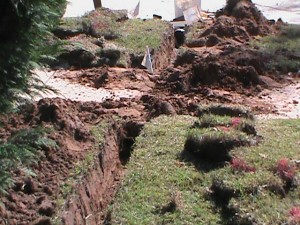
Edmond Drainage System
Drainage Systems can be made up of one drain or a combination of many drains. Drainage problems can be very complex. Complex Drainage Problems may require a combination of several different types of drains all inter-connected and working together. Other times the drainage problem may be simple and straight-forward requiring only one drain or several of the same type of drain connected together.
An example of a complex drainage system would be: A French Drain in the back yard connected to a Surface Drain near a flower bed connected to several gutter downspouts, which are connected to a Channel Drain going across a driveway, which is connected to additional Surface Drain in the front yard, which runs to a Curb Fitting that lets all the water drain out on to the street.
A simple Drainage System
might consist of a Surface Drain that is connected to a second Surface Drain which runs to a Pop-up Emitter which lets water drain over the curb and into the street.
An “Exit Point” is the term used for where all the water leaves the Drainage System. Determining the Exit Point is very critical. It is one of the first things we do when diagnosing a Drainage Problem.
Drainage Systems can:
1. Keep water away from foundations — A French Drain is best because it can move Surface Water and Sub-Surface Water (water moving underground) away from the foundation. Many times less experienced companies install Surface Drains to keep water away from foundations. This can be a big mistake. A Surface Drain can’t move or drain Sub-Surface Water.
Also
A Surface Drain often can’t move enough water fast enough and easily becomes overwhelmed during a heavy rain. A Surface Drain also can’t cover or protect a broad enough area. Surface Drains should be designed in a Drainage System to be located in smaller Drainage Areas moving moderate amounts of water. Surface Drains look better than French Drains. If ,”appearance” is more important than Drainage Capacity, Go with the Surface Drain. Just know what you are getting into and what your expectations should be. One side of a foundation alone, can be over 100 feet. A 4 inch or 6 inch French Drain is best when protecting a large area such as a foundation.
2. Keep water away from small or enclosed areas. This might be a low area just through a gate on the side of a house, or the low area between a flowerbed and the wall of a house, or standing water on or near a sidewalk or driveway. These types of Drainage Problems are best served with Surface Drains. A Surface Drain can move water away from a low area that is relatively small. This can occur in yards, flowerbeds, sidewalks and driveways. A surface Drain is designed to move Surface Water away from a problem area to a predetermined exit point. Surface Drains are available in many sizes. How quickly they remove standing water is usually determined by the size of the pipe that is connected to the drain.
Simply put,
a Drainage System is one or a group of underground Drain Pipes that take water away from a place that has water standing on it or flowing across it. The water that is in the problem area, can be causing damage or may be inconvenient or both. (Usually Both) A simple Drainage System is a Drain for the water to enter, a Drain Pipe to move the water away from the Drain, and an Exit Point for the water to be released out of the Drain Pipe.
Drainage Systems quickly can become more complicated. Considerations must include:
How does the water get to the problem area? There may be one or many sources.
Water Sources:
1. It falls from the sky directly
2. It flows down hill over the surface (surface water)
3. It flows underground under the surface (sub-surface water)
4. It flows from the edge of a roof ( There may be many roofs near the problem area, neighbors etc.)
5. It flows from a gutter downspout
6. It flows over the edge of a gutter because the gutter is too small is is clogged
7. It flows up from the ground (seeps and springs are common in Oklahoma)
8. It flows from a sprinkler system use ( yours or your neighbors)
9. It flows from a leaking pipe ( water mains, water meters, water lines, sprinkler pipes, sprinkler valves)
There are other reasons
for Drainage Problems, the above reasons are just the most common.
Once the number of water sources is determined, a rough estimate of the amount of water that needs to be drained away on average must be estimated. This can be simplified down to “SMALL, MEDIUM, OR LARGE AMOUNTS OF WATER TO BE DRAINED AWAY. You don’t have to be an engineer trying to calculate fluid dynamics. Experience at diagnosing drainage problems helps however.
How much water needs to be moved will help determine the type and size of the Surface Drain or French Drain that needs to be installed. It also helps to determine the size of Drainpipe required for the Drainage System. A good rule to follow is, “If in doubt, install a larger Drain and Drain Pipe.” Unused Drainage Capacity is better than property damage caused by a Drain that is overwhelmed by too much water.
For home and small business use typical materials used are:
6 inch, 9 inch, and 12 inch Surface Drains –
3 inch, 4 inch, and 6 inch Drain Pipes —
3 inch, 4 inch, and 6 inch French Drains —
French Drains move more water than Surface Drains —
French Drains move Surface Water and Sub-Surface Water
Surface Drains move Surface Water only
Surface Drains look nicer than French Drains in most cases
Once the type and number of drains is determined and what size Drain Pipe will connect them, an exit point must be selected. (Where is the Drainage System going to take the water to and release it?)
The Drainage Curb Fitting
is installed when the desired exit point for the French Drain will release the Drainage Water into the Street. The Drainage Curb Fitting is rectangular in shape and made to be installed through the curb. A small section of Curb is cut out with a concrete saw. The Section is a few inches wider than the Drainage Curb Fitting. We then install new concrete around the curb fitting. Once the concrete has dried, the Drainpipe coming from a French Drain or Surface Drain is connected to the Drainage Curb fitting and then covered with dirt.
The Drainage Pop-Up Emitter is connected to the end of a Drainpipe. It is downhill from a French Drain or a Surface Drain. It is a small release basin with a green pop-up lid. When releasing water, it pops up about an inch to release the water from the French Drain or Surface Drain. When the Storm Water has moved through the Drainage System and out of the Pop-Up Emitter, the green lid closes back to its original closed position. The emitter is designed to release water out into a yard or down a hill or other desirable Drainage Exit Point where there is no curb.
Drainage System installation and design
is a big part of our business. Does your sidewalk turn into a moat after a hard rain? Does part of your yard look like a pond after a thunderstorm? Worst of all, are you experiencing concrete deterioration to your foundation, sidewalk, or driveway. CMG can design a Drainage System to solve your Drainage Problems. Our Drainage Systems can be simple or complex. We utilize, French Drains, Surface Drains, Channel Drains, Basin Drains, Basement Drains, Trench Drains, and Sump Pumps. Estimates are free!
French Drain Installation Or Do You Need A Surface Drain?
Many Folks don’t know the difference. Actually there are many differences and a few similarities. One difference is, a French Drain takes in a larger amount of water into the drain Pipe than a Surface Drain. There are advantages to Surface Drains as well.

What is a French Drain?
A French Drain is a trench dug across a problem drainage area where water flows or stands. In the bottom of the trench is a perforated pipe. A Pipe Filter is placed around the pipe to keep it clean from debris. Also, a liner is placed in the trench as well. Gravel or crushed limestone is filled in on top of the pipe until the trench is filled.

The White Material is the Trench Liner. The black material is the Pipe Filter.
A French Drain is completely different from a Surface Drain. A basic French Drain consists of a Perforated Drainpipe in the bottom of a trench. A Trench Liner is sometimes used depending on the Drainage System Design and the type of soil. The Drainpipe should have a neoprene sock around the Perforated Drainpipe.
Drainpipe
This is to ensure that the Drain Pipe does not become clogged. A trench is dug that is slightly wider than the French Drainpipe that is being used. There are several sizes of French Drainpipe. Three Inch, Four Inch, and Six Inch are the most common sizes of French drainpipe. The dirt that is taken out to make the trench is hauled away. It is replaced by some type of small stone or gravel depending on what is desired or available.
I prefer crushed 1 inch limestone. It is the most economical option in my area. Pea Gravel or some other type of small stone can work just as well.

French Drain Protecting Driveway
The limestone or gravel is placed in the trench on top of the perforated Drainpipe and filled all the way to the surface (ground level). In some cases where the French Drain needs to be deep or is being placed in sandy soil, a special trench liner must be placed in the trench before the perforated Drainpipe or the Gravel are installed. This helps maintain the integrity of the trench over time. It also increases the cost of the French Drain and the amount of time to install it. I install a trench liner in a French Drain Most of the time.
Drainpipe Sizes
There are several sizes of French Drainpipe. Three Inch, Four Inch, and Six Inch are the most common sizes of French drainpipe.
The dirt that is taken out to make the trench is hauled away. It is replaced by some type of small stone or gravel depending on what is desired or available.
I prefer crushed 1 inch limestone. It is the most economical option in my area. Pea Gravel or some other type of small stone can work just as well.
The limestone or gravel is placed in the trench on top of the perforated Drainpipe and filled all the way to the surface (ground level). In some cases where the French Drain needs to be deep or is being placed in sandy soil, a special trench liner must be placed in the trench before the perforated Drainpipe, or the Gravel are installed. This helps maintain the integrity of the trench over time. It also increases the cost of the French Drain and the amount of time to install it.
French Drain in Edmond
Oklahoma Drainage Installed 4 Inch French Drain with trench liner and pipe filter about one foot away from the wall where all the water was standing and penetrating the Duct Work. The French Drain ran parallel to the house for 60 Feet. At that point the French Drain transitioned to 4 Inch solid ADS Drain Pipe and continued South an additional 80 feet to a Curb Outlet installed at the street.
Bernoulli Effect
We cut the curb and installed a Curb Outlet with Acrylic Concrete to make it look nice and last without chipping.
Along the course of the French Drain, we also connected 2 Gutter Down Spouts Directly into the French Drain.
This provides more efficient movement of the storm water to the exit, but also creates suction in the French Drain behind it.
This is called the “Bernoulli Effect.” If you remember your High School Science Class.
Oklahoma Drainage has used these simple concepts many times to provide a solution to the above problem.
Water still had to be vacuumed out of the Duct Work. But Future water was and is kept out of the Duct Work and Floor Vents. Also, the Foundation Stays Dry. No mold or foundation Break Down.
Oklahoma Drainage – We install French Drains, Channel Drains, Surface Drains, Sump Pumps and Sod.
If You live in Oklahoma City and water is damaging your foundation, we can install a French Drain for you.
Water may be standing on your driveway. Channel Drain Installtion is a Solution.
If you live in Edmond and have water flooding your basement, we can install a Sump Pump for you.
Flooding in your flowerbed can be solved with a Surface Drain.
If you live in Yukon and need grass to grow, we can install Sod too!
Check Out Parts of a French Drain

French Drain and Dirt Work

A French Drain is completely different
from a Surface Drain. A basic French Drain consists of a Perforated Drainpipe in the bottom of a trench. A Trench Liner is sometimes used depending on the Drainage System Design and the type of soil.
The Drainpipe should have a neoprene sock around the Perforated Drainpipe. This is to ensure that the Drainpipe does not become clogged. A trench is dug that is slightly wider than the French Drainpipe that is being used.
French Drain Design
must take into account many variables. One consideration for a French Drain that many times is missed, is the type of soil. French Drain Design must take into account the type of soil that the French Drain runs through.
Type of Soil
If the soil is “Tight or made up of Clay, A French Drain Liner may not be necessary. The Gravel or Limestone that is used to fill the French Drain trench may be all that is needed to maintain the integrity of the trench over time. This means that dirt will not mix in with the French Drain Gravel and clog it up over time.
This is not the case however if your soil is sandy or loose. A Trench Liner should be used to prevent this type of soil from moving into the gravel of the French Drain. Trench Liners are relatively inexpensive and are not hard to install. If you are not sure what to do, then install the Trench Liner in the French Drain.

Installation of a French Drain in Edmond Oklahoma
Drainage System
Drainage Systems can be made up of one drain or a combination of many drains. Problems can be very complex. Complex Drainage Problems may require a combination of several different types of drains all inter-connected and working together. Other times the drainage problem may be simple and straight-forward requiring only one drain or several of the same type of drain connected together.
Oklahoma Drainage and Sprinkler Repair — Installing – French Drains – Surface Drains – Channel Drains – Sump Pumps
Providing Expert Sprinkler Repair – Broken Sprinkler Pipes – Sprinkler Head Adjustment – Sprinkler Valve Replacement
Servicing all of Central and Western Oklahoma since 1993.
French Drains as part of a Drainage System –
Many times people use the term ” French Drain” as general name for a Drain used in or around your home. French Drains are designed to move a lot of water over a large, flooded area. They are also designed to take water in on the surface of the ground or below the surface of the ground. This is very important if the water coming into the flooded area is moving through the ground or coming up from underneath. ” Sub Surface Water Movement.” The picture below is not a French Drain!

A French Drain looks like this

A French Drain Can Handle Standing Water
A French Drain can take in water in a broad area. It can move a much larger volume of water compared to a Surface Drain. Also, it can move sub surface water moving into the area where a Surface Drain won’t move any water at all.
Surface Drains are designed to move surface water only on a smaller scale in confined areas.
Each solves specific drainage problems. A Drainage System may use one or both together or even several using many types of drains.
Beef Up
Another way to beef up a French Drain is to connect gutter down spouts in front of the French Drain. The water coming off the roof causes suction in the French Drain Behind it. This greatly increases the French Drains ability to move water without increasing the size of the French Drain Pipe.

Gutter Downspout Connected to 6 Inch French Drain
In Business since 1993.
Oklahoma Drainage and Sprinkler Repair recently diagnosed a Drainage Problem in South Oklahoma City. The Home owner had a sump Pump in their basement that was fed from a French Drain outside the Basement Wall. The French Drain was 14 feet down along the Stem wall of the house. The French Drain Pipe was cheap and had collapsed. We brought in a Mini Excavator and dug up the pipe and replaced it with Durable ADS 4 inch perf/soc French Drain pipe. In the end, we were able to dig up the pipe and Replace it.

New Trench for French Drain
Next we installed a new exit for the water by installing a curb fitting.
No more flooding in the customers basement. A few weeks later our customer was able to lay carpet in the basement with no problems.

French Drain Installed Along Stem Wall

FRENCH DRAIN CONNECTED TO GUTTERS
Many different types of Drains can be hooked together by one Drainpipe. The Drainpipe then running to an Exit Point makes up a Drainage System.
One common type of Drain used in a Drainage System is A “French Drain.” Many times a French Drain is installed close to a building foundation or in a low area next to a home or business. This puts the French Drain in close proximity to Gutter Down Spouts. Rather than have water come off the roof and out the Down Spout and on to the ground below, many times it is much better to tie a Gutter Down Spout Directly into a French Drain or near by Drain Pipe depending on the Drainage System Design.
Connecting The Down Spouts Directly into a French Drain is much more efficient and causes suction to occur in the French Drain. Connection of Gutter Down Spouts to a French Drain makes the Drainage System work better.
Standing Water
Do you have water standing in your yard after a hard rain? Does your sidewalk become a moat during a thunderstorm? Is standing water causing your foundation to deteriorate and break down? Is water seeping into your home and causing mold?
Storm-water run off can cause many types of problems. Oklahoma Drainage and Sprinkler Repair can diagnose your drainage issues and design a Drainage System to fit your specific needs. We install many types of drains including: French Drains, Channel Drains, Surface Drains, Basin Drains, Trench Drains, Basement Drains, and Sump Pumps.

Colored Gravel covering a French Drain